For a long time now, I have consistently avoided answering my phone whenever it’s a number I don’t know, and I have always refused to call people unless absolutely necessary. Which is the reason why the concept of communication avoidance captivated me in the BCM312 week two lecture and made me consider how significantly less social myself and our society has come to in the recent years particularly after lockdown when very little social interaction was going on. It caused me to reflect on myself and how I prefer to text instead of call particularly if the conversation is confrontational. I feel that the meaning of this concept is significant, and I want to research and discover more about it.
For this research task I formulated my research question to be “To what extent do people avoid communication on their phones” This topic allows me to focus into why people choose to avoid communication, and the lengths they will go to avoid communication on their phone. I think the topic is relevant to this generation as communication avoidance comes with a cost to today’s society as it slowly eats away our human nature of empathy. John Suler says, “For some the lack of physical presence may reduce the sense of intimacy, trust, and commitment in the therapeutic relationship. Typed text may feel formal, distant, unemotional, lacking a supportive and empathic tone.” — meaning that we are slowly being unable to understand and relate to each other’s feelings.

I discovered this concept very close to home as I profoundly reflect onto my own behaviour of communication. I used to believe that I was a talking over messaging person because I used to be when I was younger, but now that I am older and have experienced conflict and different types of people, I don’t feel comfortable talking over the phone. I often prefer to hide my face over a text message when I have to show emotions of sadness, anger or embarrassment. I want to discover why individuals (counting myself) will in general do this and the results of it. Studies have shown that “the complex interweaving of logic, personal preference, and concession to social constraints that goes into adolescents’ choices to call versus text”. (Blair, 2013) When we talk about texting, there is significantly less pressure to respond immediately. On the other hand, it is hard for people to handle “awkward silences” (Vnucec, 2019) if you don’t respond right away during a phone call. In this way, messaging gives you the time you need to frame your message in the most fitting or needed manner without pressure.
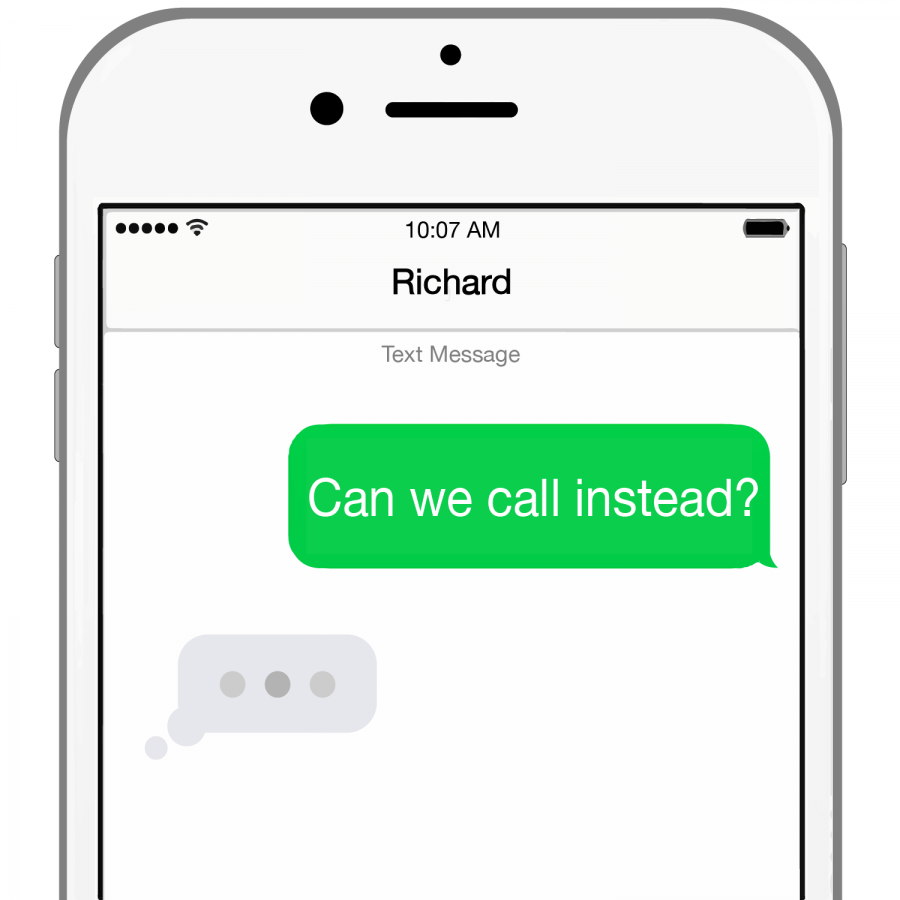
Although, texting has been benefiting the world to become more mobile and coinvent it comes with a cost. As more and more people prefer to text over talk, people are slowly losing the ability to empathise. “Texting has overtaken the intimacy of meaningful messages as it lacks facial emotions, body proximity and endless array of other nonverbals during in-person discussions which easily allows miscommunications often” (Ahmed, 2018). It also takes away empathy as it undermines people’s emotions as they have to add in emojis to set a certain tone to a message. “The main reason why texting has taken away our empathy is due to the fact that it detaches emotions when reading out a text, when empathy is sharing the same emotion as a person is feeling” (Green, 2019).
How communication functions today:
It is evident that in the last couple of years people have started to prefer texting over talking. Here are some statistics, which show clearly the way of communicating is changing:
- 5 billion people around the world have the ability to send and receive messages via SMS. This is a drastic increase from the 1 billion mobile subscribers in 2003.
- The number of monthly texts sent has increased by more than 7,700% over the last decade.
- 47% of US smartphone users say they couldn’t live without their devices.
- The average user will tap, swipe or click on their phone over 2000 times per day
- Text messages have a 209% higher response rate than phone, email, or Facebook.
- SMS open rates are as high as 98%. (Vnucec, 2019)

Conducting secondary research has led me to find out that while sending and receiving information via text message has its ease-of-use and time-saving conveniences during the day, it seems many can “unknowingly become so reliant on a text-based message for these day-to-day eases, that they may begin to hide behind a text message to avoid an array of self-disclosure, whether positive or negative, in close relationships” (Sarla, 2020). “Self-disclosure is a practice of communication where one person shares information, such as thoughts, feelings, likes/dislikes, goals, failures, about herself or himself to another” (Carter, 2017). Sharing of this information with someone requires peeling back layers. As you peel back one layer, you reveal more about yourself and about the other. Over time, through transparent, honest, back-and-forth disclosure, your relationship should develop and strengthen. Text-messaging, however, dampens this attempt to reach the center, namely due to the lack of human presence, whether over the phone or in person. I believe it would be interesting to focus my research on why there is a communication avoidance on phones and the lack of empathy our society now has due to this avoidance. I look forward to the weeks to come as I develop my research project!
References:
Ahmed, S, 2018. Texting is making us more emotionally ignorant. The Statesman, February 25. [Accessed 20 March 2021] https://journals.sagepub.com/doi/abs/10.1177/0044118X13499594
Blair, B.L., Fletcher, A.C. and Gaskin, E.R., 2015. Cell phone decision making: Adolescents’ perceptions of how and why they make the choice to text or call. Youth & Society, 47(3), pp.395-411. [Accessed 20 March 2021] https://journals.sagepub.com/doi/abs/10.1177/0044118X13499594
Carter, Z, 2017. Are you hiding behind your texts? Psychology Today, June 27. [Accessed 20 March 2021] https://www.psychologytoday.com/us/blog/clear-communication/201706/are-you-hiding-behind-your-texts
Green, E, 2019. How technology is harming our ability to feel empathy. Street Roots, February 15. [Accessed 20 March 2021] https://www.streetroots.org/news/2019/02/15/how-technology-harming-our-ability-feel-empathy
Hall, J.A. and Baym, N.K., 2012. Calling and texting (too much): Mobile maintenance expectations,(over) dependence, entrapment, and friendship satisfaction. New media & society, 14(2), pp.316-331. [Accessed 20 March 2021] https://journals.sagepub.com/doi/abs/10.1177/1461444811415047
Sarla, G.S., 2020. Texting or Calling: A Comparison. Journal of Open Source Developments, 7(2), pp.18-21. [Accessed 20 March 2021] https://www.researchgate.net/profile/Gurmeet-Sarla-2/publication/343601155_Texting_or_Calling_A_Comparison/links/5f33a37fa6fdcccc43c2114d/Texting-or-Calling-A-Comparison.pdf
Smith C, Foster M, 2014. Communication Avoidance in the age of mobile devices. Psychology Today, November 20. [Accessed 20 March 2021] https://www.psychologytoday.com/us/blog/reinvent-yourself/201411/communication-avoidance-in-the-age-mobile-devices
Vnucec, I, 2019. Why do people rather text than talk? Medium, April 23. [Accessed 20 March 2021] https://medium.com/@paldesk/why-do-people-rather-text-than-talk-a0a87d00d517
 Ashley's Blog